
How a dispute arises
- The neighbour dissents from a party structure or excavation notice.
- No written consent arrives within 14 days, so dissent is assumed.
- A disagreement arises later, for example about damage, costs or a change to the work.
How it is settled
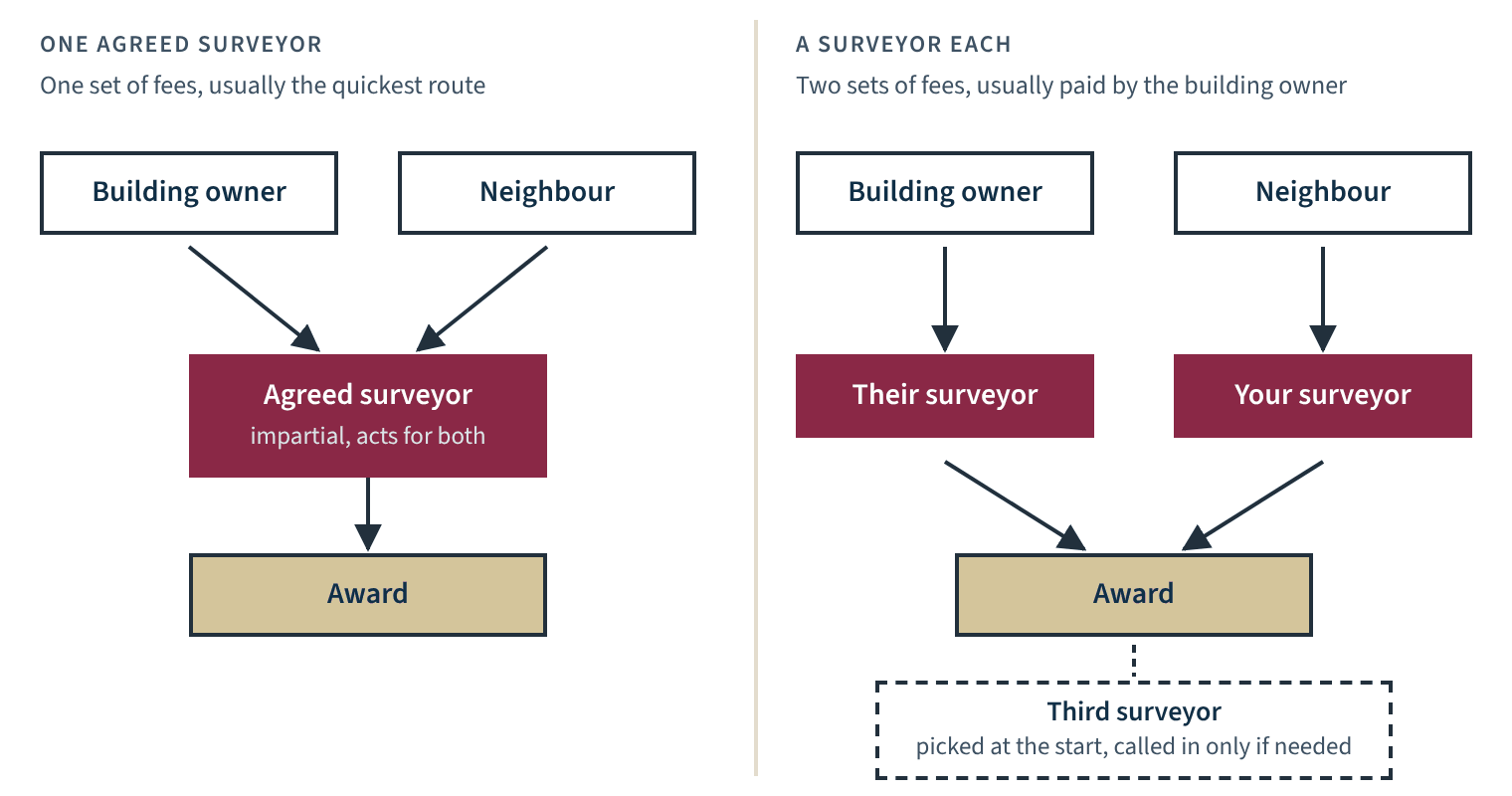
The owners either agree on one surveyor or appoint one each. The surveyors then make an award covering whether the work may go ahead, its timing and method, and the costs. See one surveyor or two.
If the surveyors disagree
Two appointed surveyors select a third at the outset. Either owner, or either surveyor, can ask the third surveyor to decide a point the others cannot settle. See the third surveyor.
If an owner disagrees with the award
Either owner may take the award to the county court on appeal, but only in the 14 days that start on the day it is served. See appealing an award.
Disputes the Act does not settle
Arguments about where the boundary lies, rights of light, planning, general noise or trees fall outside the Act. They need other routes, such as mediation, the council or the courts.
Keeping it civil
Most party wall matters are settled without any real conflict. Replying on time, using experienced surveyors and keeping communication polite does more to prevent disputes than any procedure.
Common questions
Do we need solicitors for a party wall dispute?
Rarely. The Act's procedure is designed to keep matters out of court. Legal advice is mainly needed for appeals, or for disputes outside the Act.
Can we use mediation?
For disagreements outside the Act, yes. Within it, the surveyors' procedure is the route the Act provides.
Where this comes from in the Act
- Section 5: Disputes arising under sections 3 and 4
- Section 6: Adjacent excavation and construction
- Section 10: Resolution of disputes
Links go to the official text of the Party Wall etc. Act 1996 on legislation.gov.uk.